
ANANTA does not put a fictional stamp on its setting and leave it there. In the official Games Press release announcing the game’s January 15, 2027 worldwide launch, NetEase states plainly that the urban open-world is “inspired by real-world metropolises such as Shanghai, Hangzhou, and Tokyo.” Those three city names are the entire officially sourced basis for the map. Everything more specific you have read — “this tower is the Oriental Pearl, that pagoda is Leifeng” — comes from what individual journalists recognised in a hands-on demo, not from a developer statement. Keeping those two layers apart is the point of this article.
1. What the official line actually says
Pull the sourced sentence to pieces and note its exact shape:
- The subject is plural and hedged. “Metropolises such as” Shanghai, Hangzhou and Tokyo — the three are examples, not a closed list, and none is pinned to one specific in-game city by the release.
- It covers the game as a whole, not one map. The same release is the one that names Chongxiao as “the game’s second major city” and confirms the free-to-play launch across the official PC client, Steam, PS5 and mobile, with “over 17 million global pre-registrations from players across 110 countries and regions.”
- It says nothing about 1:1 geography. The release never maps “Shanghai = Chongxiao” or “Tokyo = Nova City.” Any such pairing is interpretation.
The single most reliable takeaway is structural, not visual: ANANTA is a two-city game — the coastal Nova City and the sky-and-water Chongxiao — drawn from a pool of East-Asian megacities. That framing sits behind our city overview for Nova City and Chongxiao, and behind the “city origins” entry on our timeline.
2. Where the sharper claims come from — and how to read them
The specific landmark identifications circulating online trace mostly to a 4Gamer gamescom 2026 hands-on report (dated 2026-09-02), in which the editor, watching Chongxiao on a guided demo by two Naked Rain members, wrote down buildings he thought he recognised: a tower holding a golden sphere, an upturned glass spire, a pagoda lit at night. He flagged these as personal guesses. Our Chongxiao page already records that coverage and explicitly keeps the “疑似” (presumed) wording separate from the official statement — because a journalist’s pattern-matching is not a developer confirmation.
Read them as colour, not canon:
| Real metropolis | What the official release supports | What is only press speculation |
|---|---|---|
| Shanghai | Named in the release as an inspiration source | The Bund skyline, Oriental Pearl, Wukang Road “appearing in Chongxiao” |
| Hangzhou | Named in the release as an inspiration source | West Lake, Leifeng Pagoda, Longjing tea fields, “robot street life” |
| Tokyo | Named in the release as an inspiration source | Nova City’s neon-dense, Japanese-flavoured downtown reading |
None of the right-hand column has an official source we can point to, so none of it is a term entry on this wiki. The Naked Rain studio profile — the NetEase studio with sites in Hangzhou and Montreal that 4Gamer credits for mixing “Hangzhou and Shanghai into one city” — is the closest thing to an explanation, and even that observation is the journalist’s, not the studio’s.
3. Reading each city against its likely borrowings
With the speculation labelled as such, you can still make sense of the design without inventing anything.
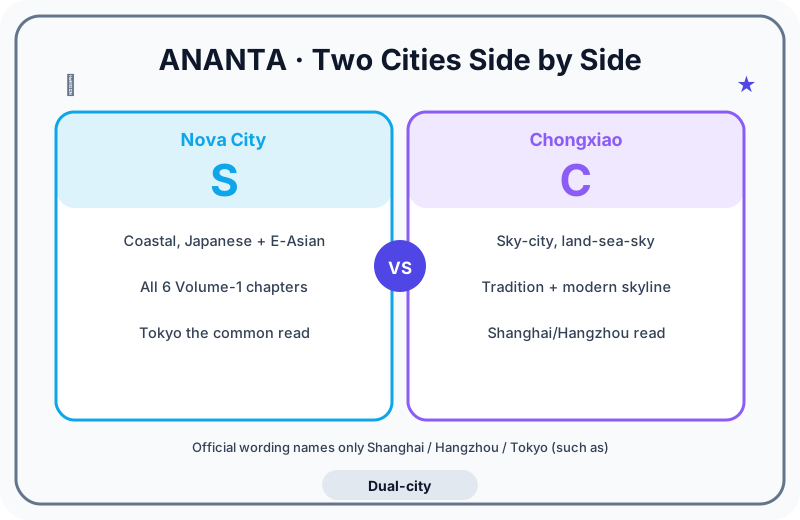
Nova City — the coastal starter city. Our city-origins timeline node describes it as a “large modern coastal metropolis blending Japanese and East-Asian urban design,” with a residential / commercial / financial core and a full day-night cycle. The “Japanese-flavoured” note is why Tokyo is the natural read for Nova City’s neon downtown — and it is our own sourced description, not a fan guess. Nova City is also where, per our story archive, all six documented Volume 1 chapters take place, which is what makes it the densest launch-stage city.
Chongxiao — the revealed second city. Introduced at gamescom 2026 as “the game’s second major city,” it is the one that visibly leans on the Chinese megacity pool: traditional scenery folded into a modern skyline, land–sea–sky transport, and a life-sim layer (cinemas, mahjong halls, arcades, cat cafés, hot springs) that the hands-on reports treated as Chinese-urban in flavour. That flavour is widely attributed to Hangzhou and Shanghai in press coverage; the fact we can stand behind is only that both are named as inspirations in the release.
The honest synthesis: the coastal, Japanese-tinged city reads as the Tokyo end of the pool; the traditional-plus-modern sky-city reads as the Shanghai/Hangzhou end. The release supports the pool; the assignment to a specific city is editorial reading, and this article labels it as such.
4. Why NetEase is shipping a mash-up and not a clone
There is a practical reason the wording hedges. A game that says “this is Shanghai” inherits a different set of expectations — and obligations — than one that says “inspired by” a group of cities. Naming three metropolises together, and putting the developer studio (Naked Rain) partly in Hangzhou and partly in Montreal, lets the world borrow the density of Shanghai, the lake-and-tea scenery of Hangzhou and the neon verticality of Tokyo without committing to a documentary map of any one. It also keeps the door open: the release says “such as,” so further cities can be folded in later without contradicting anything already stated.
For players this changes what to expect at launch: two big cities, a shared visual DNA drawn from East-Asia’s skyline-heavy megacities, and per-city content the developer has committed to at “no fewer than 100 hours” each. It does not mean a GPS-accurate Shanghai — that was never claimed.
5. Our own numbers: how much of the map the site already documents
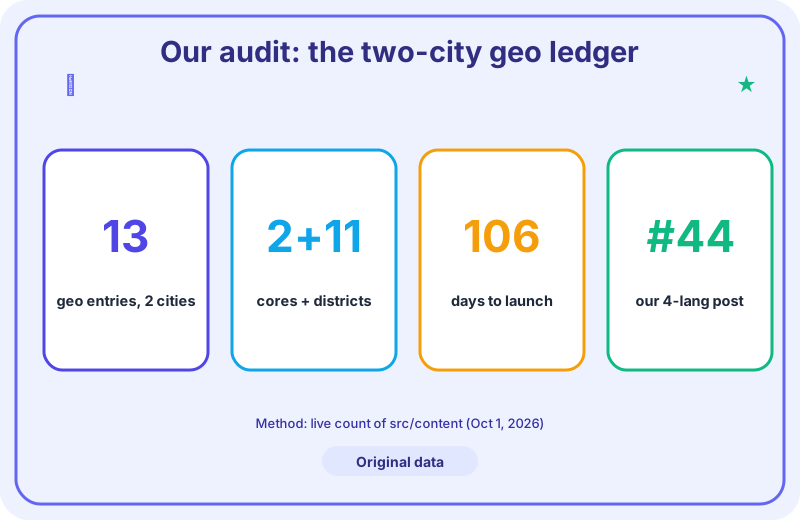
Method — live count of src/content/ and src/data/ on October 1, 2026, identical across all four languages.
- Our glossary carries 13 geo-class entries for the two cities: the 2 city cores (Nova City, Chongxiao) plus 11 named districts and landmarks — Central Business District, Residential Quarter, Old Town, Prosperous Shopping District, Seaside Area, Underground Tunnels, A.C.D. Headquarters, Anbo Industrial, High-Altitude Layer, Blue Cat Logistics, Dream Garden. By object class, geography is the second-largest documented set on the site (13) after the 15-entry character roster — ahead of the 14 weapons we catalogued in the weapon-system breakdown.
- That 13-vs-15 spread is the original point: before a single player has logged in, the two cities are already the most-detailed non-character layer of this game’s known map. The map tool reflects it — see the interactive map.
- The main-story density is one-sided: all 6 Volume 1 chapters map to Nova City, 0 to Chongxiao so far (see the story index) — consistent with Chongxiao being the showcase city and Nova City the starter.
- This is our 44th four-language post. Distance to the release countdown: 106 days to January 15, 2027; 22 days to the Golden Joystick voting close we covered on the nomination post.
6. Bringing the thread back to what is checkable
If you want a rule of thumb for the rest of the pre-launch window: trust the three-named-metropolis line, distrust the pointed-at-a-building line. The former is in the release; the latter is a screenshot and a hunch. The places on this site that never cross that line are the two city pages, the “city origins” timeline node, and the platform page that pins the January 15, 2027 launch to the same PC / PS5 / mobile wording the release used. The rest of the “which tower is which” chatter stays exactly where it should — in the reporting, labelled as speculation, not promoted to a term entry.
FAQ (Frequently Asked Questions)
What real-world cities is ANANTA based on?
The official Games Press release states the game’s cities are “inspired by real-world metropolises such as Shanghai, Hangzhou, and Tokyo.” Those three named cities are the only sourced basis; the release does not match any one of them to a specific in-game city.
Is ANANTA set in Shanghai?
Not officially. Shanghai is one of three metropolises named as an inspiration for the game’s cities as a whole. Treating Chongxiao or Nova City as “a copy of Shanghai” comes from press hands-on impressions, not a developer statement, and we keep it labelled as speculation.
How many cities does ANANTA have at launch?
Two have been revealed: the coastal Nova City and the second major city, Chongxiao, introduced at gamescom 2026. The official wording is “such as,” so further cities are not ruled out — but none beyond these two has been announced.
What is the difference between Nova City and Chongxiao?
Nova City is the coastal starter city, blending Japanese and East-Asian design, and it is where all six documented Volume 1 chapters are set. Chongxiao is the sky-and-water second city leaning on the Chinese megacity pool, with land–sea–sky transport and a heavy life-sim layer. See both city pages.
Did Tokyo inspire any part of ANANTA?
The official release names Tokyo as one of the three real-world inspirations for the game’s cities collectively. Our own city-origins entry describes Nova City as blending “Japanese and East-Asian urban design,” which is why Tokyo is the most common read for Nova City — but the release does not state the pairing outright.
Who developed ANANTA, and why does the map feel like a mix?
ANANTA is by NetEase Games and Naked Rain, a studio 4Gamer reports has sites in Hangzhou and Montreal. A team split across a Chinese and a Canadian studio naturally blends Shanghai- and Hangzhou-style density into one city, which is the mix reviewers noticed. See the Naked Rain term page.
How much of the map is already documented on this wiki?
We currently list 13 geo entries for the two cities — the 2 city cores plus 11 named districts and landmarks — which is the largest object class on the site after the 15-entry character roster, ahead of the 14 weapons and the 6 Volume 1 story chapters.
When does ANANTA launch and where can I read the sourced facts?
January 15, 2027 worldwide, on the official PC client, Steam, PS5, iOS and Android, free-to-play with no character gacha. The game-info page pins these to the same wording as the release, and the release countdown tracks the 106 days remaining.