
“Is ANANTA more like Genshin — swap characters and pop skills — or more like GTA — one guy roaming the city?” This is the single most-asked question in the community lately.
The answer is: somewhere in between. NetEase’s official line for ANANTA is multi-character switching with distinct identities/professions, the combat core is dynamic martial arts plus environmental interaction, and there is no character gacha pool — you unlock characters for free through the story and open-world exploration. This piece does one job: break the confirmed combat and switching mechanics into 5 points. Wherever skill names, multipliers or numbers are still unannounced, we mark them “pending official confirmation” and do not speculate.
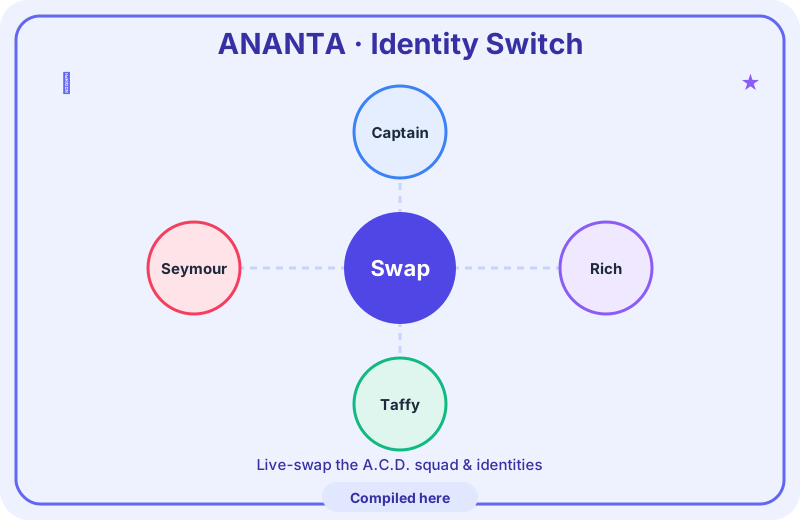
Mechanic 1: Not gacha — “squad identity switching”
ANANTA has no traditional gacha, confirmed by multiple outlets. Characters are unlocked mainly by advancing the main story, completing quests and exploring the world (see the Character Acquisition term). At Gamescom 2026 the trailers and press releases kept stressing “experience multiple identities / diverse roles” — you switch in real time between unlocked characters instead of grinding one to the max. This continues our earlier Zero-gacha and Character Switching piece: that one asked “is it a gacha game”, this one focuses on “how you fight once you swap in” — the system is defined in the new Identity Switching term.
Mechanic 2: Dynamic martial arts — the whole street is the arena
Official copy describes combat as “dynamic martial arts combat”: punching, throws and footwork that use the environment and nearby objects, with the Chongxiao (Lingyun City) side leaning explicitly toward practical kung-fu such as Shaolin. It is not stationary skill-trading — it is about spacing, terrain and environment. To run this combat smoothly, master movement first; the logic for web-swinging, wingsuit, hover cars and kung-fu parkour is in the Movement System Explained piece.
Mechanic 3: Everyday objects as improvised weapons — plus 14 signature weapons
The line that went viral from the Gamescom copy is “turning everyday objects into unexpected weapons” — grab a chair, a barrier or a movable prop off the street and swing it; that is exactly the new Environmental Combat term. Meanwhile our weapons wiki already catalogues 14 traceable signature weapons — by rarity 5★6 / 4★6 / 3★2, covering Catalysts (5), Gloves (3), Bows (2) and Blade, Hammer, Spear, Yo-yo (1 each). Who suits which is in Which of the 14 Weapons First and the Weapons Catalogue. Picked-up props give instant offense; signature weapons give long-term growth — the two run in parallel.
Mechanic 4: Six elements — but don’t rush a “counter table”
The 14 weapons span 6 elements: Spark, Chaos and Bloom have 3 each; Surge and Psyche have 2; Void has only 1 (the scarcest). Elements shape skill schools and team ideas, but the elemental counter multipliers are still unannounced — pending official confirmation. Any “element X beats element Y by N%” figure right now is community speculation and is not published here. See the Items Catalogue and the Glossary Cheatsheet.
Mechanic 5: Where characters come from, and how much content there is
The business model is free-to-play, no character gacha pool, cosmetics-only monetization (per NetEase-affiliated media), with characters obtained free via story and exploration. On scale, official sources cite “about 100 hours of content per city”; Nova City and Chongxiao together form the “Two Cities, One Epic Adventure” world. Platforms and the release date (PC official client + Steam, PS5, iOS, Android, January 15, 2027) are on the Game Info page.
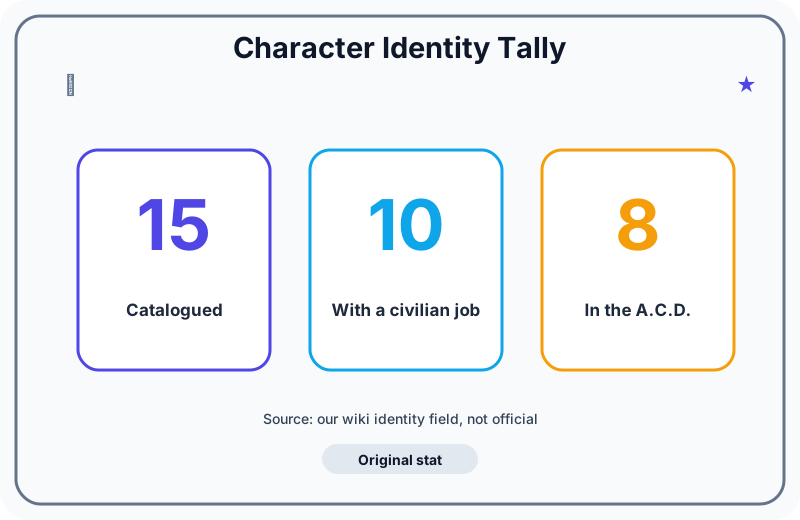
Our own stat: doing the math on “identity switching”
Tallying the identity field across the 15 characters in our src/content/characters/, at least 10 carry a civilian identity/profession that runs alongside their combat role — Taffy (ex-courier), Seymour (RV hacker), Thermo (ex-Anbo thermal engineer), Mechanika (freelance mechanic), Bansy (street graffiti artist), Alan (information broker / part-time model), Aileen (maid-café owner), Ringo (high-school liaison), Yinglong (temple steward), Shi Ye (logistics support). This directly backs the official “experience multiple identities” pitch: what you switch is a social identity, not just a skill kit. In the same set, 8 of 15 belong to the A.D.P. (A.C.D.) system — the core of your switching squad; the full breakdown is in the Factions index.
Getting started: a combat route that actually works
- In Story Mode, get the A.D.P. core — the Captain and Rich — to comfort first, building intuition for short switch-in animations;
- In street brawls, grab an environmental object to open, then swap to a character wielding a signature weapon to finish;
- In Chongxiao, prioritize dynamic-martial-arts combos, using rooftop and wall terrain for spacing (see Chongxiao Explained);
- For who-swaps-in-when ideas, build a squad by role in the Team Builder, then read character details in Guides.
Concrete numbers, skill names and counters will be updated once official, traceable figures land.
FAQ
Is ANANTA a gacha game? How do you get characters?
No. Official sources and multiple outlets confirm there is no traditional gacha and no character pool; characters are unlocked free through the main story, quests and open-world exploration, with monetization focused on cosmetics.
Can you switch characters in ANANTA? How?
Yes. The game centers on “multi-character switching / experiencing multiple identities” — you swap in real time between unlocked characters, switching both social identity and playstyle rather than maxing one character.
What is ANANTA’s combat like?
Officially “dynamic martial arts combat”: punching, throws and footwork that use terrain and nearby objects, with Chongxiao/Lingyun leaning toward practical kung-fu like Shaolin. It rewards spacing and environment over stationary skill-trading.
Can everyday objects really be used as weapons?
Yes. The Gamescom copy explicitly mentions “turning everyday objects into unexpected weapons” — grab movable street props as improvised weapons. This runs alongside signature weapons (14 in our catalogue): one for instant offense, one for long-term growth.
Does ANANTA have elemental counters?
There are 6 elements (Spark, Chaos, Bloom, Surge, Psyche, Void), but the counter multipliers are not yet published. Any “X beats Y by N%” claim is community speculation and is treated here as pending official confirmation.
Do you have to pay in ANANTA?
Free-to-play, no character gacha pool, primarily cosmetics-only monetization (per media coverage). Characters come free from story and exploration; further purchase details await official announcements.
How long is one city?
Official sources cite “about 100 hours of content per city”, with Nova City and Chongxiao forming the two-city world. Actual hours vary by player and await the final official statement.
Who should a beginner level first, and how to team up?
Start with the A.D.P. core (e.g. Captain, Rich, Taffy, Seymour) to build short-switch intuition, then arrange a squad by role in the team builder. Until combat numbers are official, we won’t declare a “strongest”.
Before you pre-register
Pre-registration is open across platforms. The combat and switching mechanics here come from Gamescom 2026 official copy and gameplay, Chinese/English outlet previews, and our own catalogued characters and weapons. Undisclosed skill names, multipliers and counters are all marked “pending official confirmation” and are not written as fact.
Data note: weapon and element counts (14 weapons / 6 elements / rarity 5★6·4★6·3★2) and the “at least 10 of 15 characters carry a civilian identity, 8 belong to A.C.D.” figures are tallies from our own
src/content/, not official determinations. Mechanic descriptions come from traceable media copy; undisclosed numbers await official confirmation.