
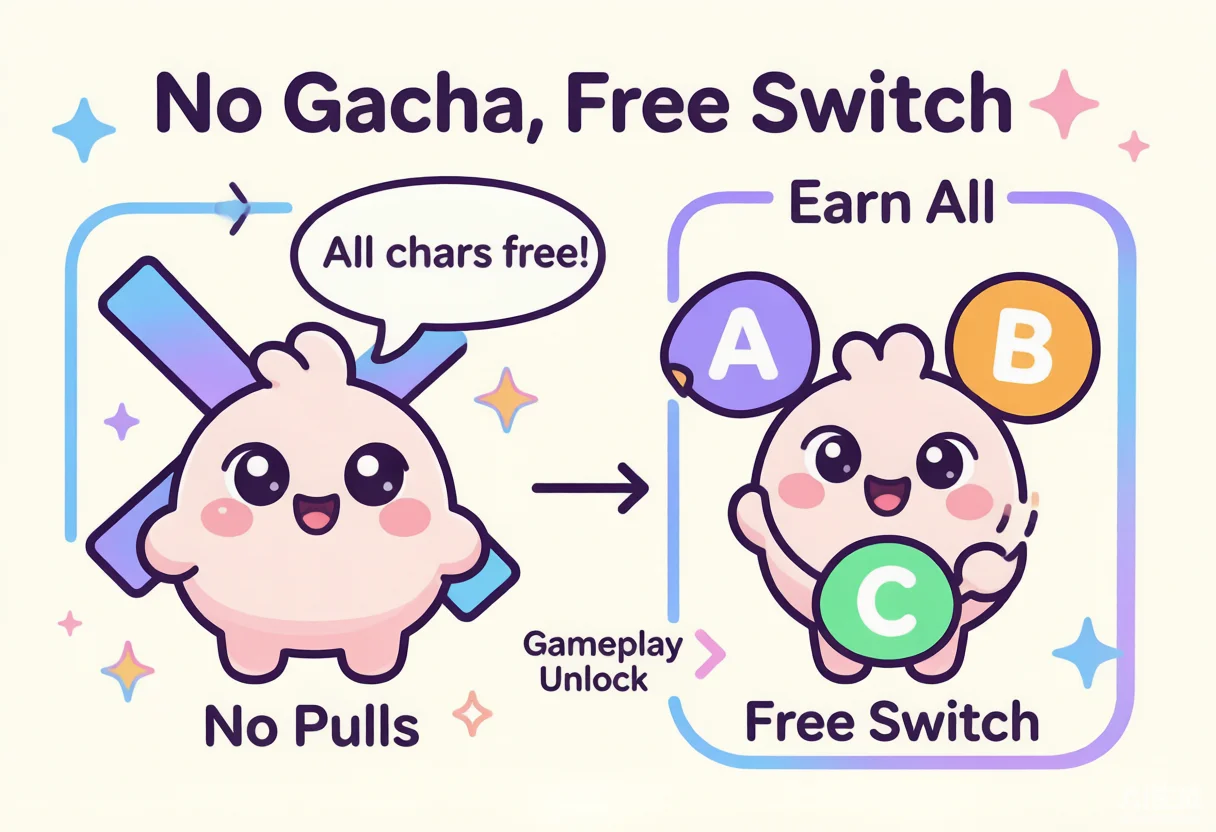
This is one of the most discussed — and most misunderstood — topics in the Ananta community. Some players see Ananta as a traditional anime RPG with inevitable gacha pulls, team compositions, and elemental synergies. Others view it as an open-city experience with free-form multi-character switching — no squad needed, switch to whoever you want, whenever you want.
Which is it? Let’s break it down with confirmed official information.
The Bottom Line: No Gacha, All Characters Free
On September 24, 2025, multiple gaming outlets confirmed: ANANTA will not feature a traditional character gacha system.
“Ananta is free-to-play with no character gacha. All characters are earned through gameplay.” — Ananta Wiki
How Do You Get Characters?
All playable characters are unlocked through:
| Method | Description |
|---|---|
| Main Story Quests | Core characters unlock naturally as the story progresses |
| World Exploration | Discover and unlock hidden characters across the city |
| Side Quests | Complete personal storylines for specific characters |
| Achievements/Milestones | Unlock characters by reaching specific game goals |
In short: the more you play, the more characters you get. No luck required — just commitment.
Why This Decision Matters
Player Impact
| Dimension | Traditional Gacha | Ananta |
|---|---|---|
| Character Cost | Requires pulls (free/paid) | Completely free, in-game unlock |
| Acquisition Certainty | Random — may never pull desired character | Guaranteed — complete conditions, get character |
| Spending Pressure | High (limited banners, pity systems) | Extremely low |
| Character Progression | Duplicate pulls needed for breakthroughs | Progress through gameplay |
Industry Significance
In a market dominated by gacha-driven anime games, Ananta’s choice is almost rebellious. It reflects a core philosophy from Naked Rain studio:
Let skill, effort, and commitment matter more than randomness.
The Character Switching System: How It Actually Works
“No gacha” solves the “how to get characters” question — but “how to use characters” is equally important. Based on official descriptions and demo footage, here’s how Ananta’s switching mechanics function:
Not Traditional Squad Formation
In a typical RPG, you would:
- Select 3-4 characters from your roster to form a squad
- Switch between them in a fixed rotation during combat
- Optimize team composition based on elemental advantages
Ananta’s design is closer to:
- All unlocked characters are available at any time
- Switch freely based on the situation in the open world
- Each character has unique movement and combat styles
Character Switching in Action
From the gameplay trailer, we can see:
- Captain: Tentacle-swinging through city skylines — perfect for rapid traversal
- Taffy: Morphing motorcycle for high-speed ground mobility
- Seymour: Long-range firepower ideal for safe-distance combat
- Richie: Stealth capabilities suited for assassination and reconnaissance
This means character switching isn’t just a combat mechanic — it’s core to exploration and puzzle-solving. Different characters have different interaction capabilities, and you’ll need to switch flexibly to complete various tasks.
Two Major Community Misconceptions
Misconception 1: “No Gacha = No Character Acquisition System”
Some players worry that no gacha means few characters or undifferentiated characters.
Reality: No gacha only changes the acquisition method — it doesn’t affect character quantity or depth. Ananta has revealed 12 characters so far, each with independent skill systems, combat styles, and narrative arcs.
Misconception 2: “Character Switching = Traditional Squad Building”
Some players approach Ananta with traditional RPG logic, trying to analyze “optimal team compositions.”
Reality: Ananta’s switching is far more flexible. You don’t pre-build a squad — in the open world, you switch characters on the fly based on mission needs. This is closer to GTA V’s three-protagonist switching than a traditional RPG party system.
Cross-Game Comparison
| Game | Character Acquisition | Switching | Squad System |
|---|---|---|---|
| Ananta | Gameplay unlock | Open-world free switch | No traditional squad |
| Genshin Impact | Gacha | 4-character combat switch | 4-person squad |
| Zenless Zone Zero | Gacha | 3-character combat switch | 3-person squad |
| GTA V | Fixed 3 characters | Open-world free switch | No squad |
| Watch Dogs: Legion | NPC recruitment | Open-world free switch | No squad |
Ananta’s model most closely resembles a GTA V + anime-style hybrid — open-world free switching combined with rich character designs and skill systems.
Business Model: If Not Gacha, Then What?
If characters are free, how does the game make money? While the full monetization model hasn’t been revealed, likely revenue streams based on similar games include:
- Skins/Cosmetics: Character outfits, weapon appearances
- Battle Pass: Seasonal reward systems
- Convenience Items: Progression accelerators that don’t affect balance
- Expansion Content: Major story DLC or expansions
This model is well-established in Western markets (Fortnite, Apex Legends) and while rare in anime-style games, it’s not unprecedented.
Conclusion
Ananta’s “no gacha + free switching” design may be the most disruptive approach in anime-style open-world gaming in recent years. It addresses players’ deepest anxiety — you don’t pay for characters, you invest time in them.
Whether this design succeeds depends on two key factors:
- Unlock pacing — Can the game maintain a steady stream of anticipation and achievement?
- Switching fluidity — Are transitions between characters seamless and natural?
If both are executed well, Ananta could redefine the business model for anime-style open-world games.
August 2026 Update: Gamescom Release Date Confirms No-Gacha Policy
At Gamescom 2026 Opening Night Live on August 25, 2026, developer Naked Rain (NetEase) officially locked in January 15, 2027 as the worldwide launch date and unveiled the second major city Chongxiao. Most importantly, the studio officially reaffirmed the no-gacha commitment that’s been the most discussed feature of the project.
Officially Confirmed Monetization Details
Here’s what’s now clearly defined under the Gamescom 2026 official announcement, clearer than prior speculation:
- No character gacha whatsoever: No gacha banners, no premium currency for pulls, no random probability, no pity systems. All playable characters are unlocked deterministically through main story progression and open-world exploration.
- Pay only for cosmetics: All revenue comes from outfits/skins, vehicle skins, and player housing customization. There are no paywalls for character acquisition or combat power.
- Free-to-play base game: The entire core experience is free, no pay-to-win mechanics or character-gating.
In developer interviews, Naked Rain (under NetEase Thunder Fire) explained the design reasoning: “Our game is built around freely switching between multiple identities and characters. Locking characters behind gacha banners would contradict that core design, and older characters would be ignored when new banners drop. So we’re taking the volume path: let everyone get characters for free through play, and rely on cosmetics from a large player base rather than gacha revenue from a small number of heavy spenders.”
Officially Confirmed Character Unlock Pacing
With the no-gacha model, the studio has confirmed a steady progression pacing:
| Stage | Unlocked Characters (Example) |
|---|---|
| Start | Captain (player character, male/female options) |
| Early Story | Taffy (rabbit-eared courier) and other core team members |
| Mid Story | Seymour (hacker), Richie (long-range sniper), Bansy (graffiti artist), etc. |
| Late Story | Dila, Lykaia, and other deep-story characters |
| Exploration Bonus | Hidden characters discoverable through city exploration and NPC side quests |
This pacing is perfectly aligned with the no-gacha, no-limited-banners design — characters are permanently available forever, with no limited-time FOMO pressure. Players can complete their roster at their own pace.
Why This Is Good News For Players
- No luck required: Character acquisition is guaranteed — complete the story/exploration conditions and you get the character, no repeated pulls or waiting for reruns.
- No FOMO: Only cosmetics have timed exclusives, never characters. You don’t need to worry about missing out permanently.
- Full build freedom from day one: Since every character is free, you can plan your team compositions around all available characters from the start, not just who you’ve pulled.
The core conclusion hasn’t changed, but now it’s officially confirmed by Gamescom 2026: Ananta is a zero-gacha open-world RPG where every character is free.
This article is based on publicly available information as of July 2026, updated after the August 2026 Gamescom announcement. Game mechanics are subject to the final release.
Sources: Enduins Report, Ananta Wiki, Ananta Official Preview